


Latest Products
We keep on updating and iterating our products, optimizing the structural design and creating a more scientific and reliable slewing drive device.
-
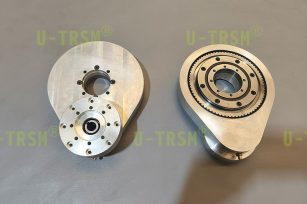
 Lightweight design and performance of U-TR...
In the field of high speed automated mechanical equipment, the performance and light weight of the core drive compone...
Detailed instructions Send mail -
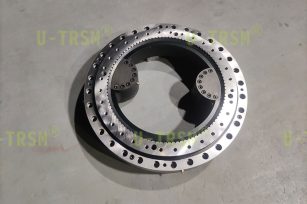 Analysis of lightweight double gear slew d...
Core Design Advantages In response to the core demands of limited installation space for automated rotating pl...
Detailed instructions Send mail -
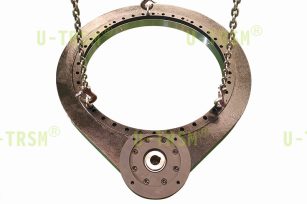 Selection and characteristics of slewing d...
This slewing drive is used in automated mixing equipment. The customer requires that it rotate in the same direction ...
Detailed instructions Send mail -
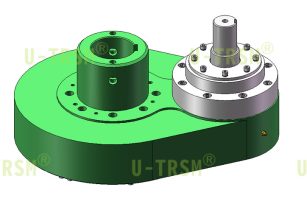 Analysis of the high speed rotating double...
This double row ball gear type slew drive is used in automation equipment. The customer requires ultra-high speed ope...
Detailed instructions Send mail
Decibel wars – precision manufacturing of gears through noise
Publish time:2025/07/09 News Views:105
Gear precision is a key factor affecting noise, and high precision gears can significantly reduce noise levels, the main relationships and mechanisms are as follows:
1. Core accuracy elements and noise relationships
Tooth pitch error (base/ pitch error): the noise is proportional to the error value, and the impact is more significant when the speed or load increases. Even if the pitch error of a single tooth is large, the noise will be significantly increased.
Tooth shape error: insufficient tooth shape accuracy directly leads to meshing impact, the node near the “concave” error will especially increase the squealing sound. Excessive roughness of the tooth surface increases friction vibration and noise frequency.
Gear ring radial runout: causes continuous changes in the circumference, resulting in modulation noise related to the rotation frequency, and the human ear is more sensitive at high speeds.
2. Influence mechanism
Mesh shock and vibration: insufficient precision leads to uneven deformation of gear force, which generates impact force at the moment of meshing in/out and triggers torsional vibration and noise.
The dynamic meshing force of the gears excites the system components to vibrate (self-tuning noise), which becomes the main sound source of the closed gears.
Node pulsating impact: the change of the relative sliding speed of the tooth surface causes a sudden change in the direction of friction to form a pulsating impact, and the larger the transmission power and the higher the speed, the more obvious impact noise.
3. Noise reduction strategies for precision optimisation
Precision grade improvement
High-precision gears can reduce noise by up to 10dB compared to low-precision gears, especially when controlling tooth shape error and tooth surface roughness.
Grade 7 accuracy has strong versatility, while grades 5-6 are suitable for precision transmission.
Design parameter optimization
Appropriately increase the degree of overlap to reduce the frequency of meshing impact.
Control the pressure angle (smaller pressure angle can reduce noise) and helix angle (more than 20°~25° may increase noise due to axial vibration).
Material and process improvement
Use of low modulus of elasticity materials (e.g. plastic gears are quieter than steel gears) or cast iron (approx. 3dB quieter than steel gears).
The use of high-performance engineering plastics such as PEEK has both self-lubrication and shock absorption.
High-precision machining process ensures the consistency of tooth shape and tooth pitch and reduces assembly errors.
Special gear grease fills in small errors and forms a protective film to reduce friction noise.
Gear precision reduces noise by reducing mesh impact, friction vibration and dynamic load transfer instability. The tooth pitch, tooth profile accuracy and tooth surface roughness are the core control points, which need to be combined with material selection, design optimisation and precision manufacturing to achieve systematic noise reduction.
- What factors need to be considered in the ...
- Gear transmission noise: problem analysis ...
- A brief analysis of heat dissipation metho...
- What is the difference between oil lubrica...
- How to improve the service life of slewing...
- What material is the seal on the slewing r...
- U-TRSM: innovators and practitioners in th...
- Analysis of the force of the spur gear sle...