


Latest Products
We keep on updating and iterating our products, optimizing the structural design and creating a more scientific and reliable slewing drive device.
-
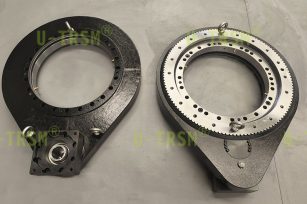
 Two-stage slewing drive with extended cent...
In response to the customer’s specific requirements for a slewing drive used on automation equipment, U-TRSM ha...
Detailed instructions Send mail -
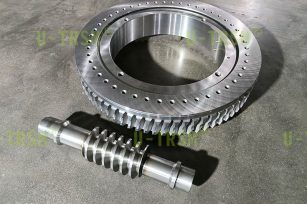 Specialised Slewing Drive Solutions For He...
In response to the specific operational requirements of heavy-duty automated rotary equipment, U-TRSM has used its ri...
Detailed instructions Send mail -
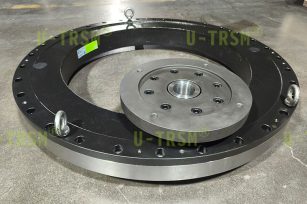 Inner gear slew drives: compact and effici...
In the application scenario of heavy duty automated equipment rotating bases, facing severe requirements such as high...
Detailed instructions Send mail -
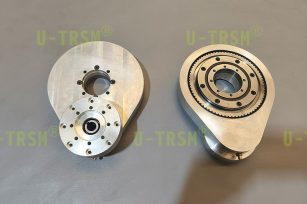 Lightweight design and performance of U-TR...
In the field of high speed automated mechanical equipment, the performance and light weight of the core drive compone...
Detailed instructions Send mail
Introduction to several common worm types in design of worm gear slewing drives
Publish time:2023/05/06 News Views:459
Worm gear slewing drive is a common type of support rotary equipment, which can transfer the power between two axes in staggered space. Compared to geared slewing drives, the vibration, impact and noise of worm gear slewing drives are significantly reduced. And the worm gear slewing drive works more smoothly, the transmission torque is relatively large, the structure is compact and can be self-locking. But the worm gear slewing drive also has certain disadvantages, that is, the transmission efficiency is low, serious heat generation. Therefore, in some occasions it’s necessary to replace the steel parts with precious non-ferrous metals to reduce the frictional heat and avoid the phenomenon of locking.
U-TRSM engineers will design different types of worm gear structures to meet the needs of our customers for different applications. Usually, our design engineers will provide the following common worms for customers to choose from:
1.Archimedes cylindrical worm (ZA): convenient processing, the most widely used, generally used in the occasions where the number of heads is small, the load is small, and the speed is low. At the same time, the number of meshing teeth is small, and the transmission efficiency is between 0.35 and 0.8.
2.Normal straight profile cylindrical worm (ZN), involute cylindrical worm (ZI): suitable for multi-head worm, high precision, high speed, few meshing teeth, transmission efficiency up to 0.9.
3.Tapered envelope cylindrical worm (ZK): more convenient processing, can be milled, ground, high precision. The number of meshing teeth is small and the transmission efficiency can reach 0.9.
4.Circular cylindrical worm (ZC): can be ground and processed, more widely used in the heavy-duty industry, the number of meshing teeth 2-3, transmission efficiency of 0.65-0.95.
In providing solutions to customers, U-TRSM has demonstrated strong design and manufacturing capabilities, and can provide customers with a full range of considerations in different equipment usage conditions to meet the needs of various application types.
- How to correctly choose bolts for installi...
- Analysis of the main factors affecting gea...
- Introduction of some applications of spur ...
- Influence of rotational inertia on the sle...
- What material is the seal on the slewing r...
- The correct selection can increase the ser...
- How should the slewing drive be maintained?
- Backlash analysis of spur gear slew drive