


Latest Products
We keep on updating and iterating our products, optimizing the structural design and creating a more scientific and reliable slewing drive device.
-
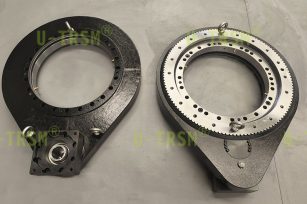
 Two-stage slewing drive with extended cent...
In response to the customer’s specific requirements for a slewing drive used on automation equipment, U-TRSM ha...
Detailed instructions Send mail -
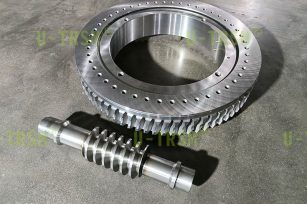 Specialised Slewing Drive Solutions For He...
In response to the specific operational requirements of heavy-duty automated rotary equipment, U-TRSM has used its ri...
Detailed instructions Send mail -
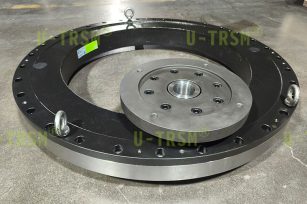 Inner gear slew drives: compact and effici...
In the application scenario of heavy duty automated equipment rotating bases, facing severe requirements such as high...
Detailed instructions Send mail -
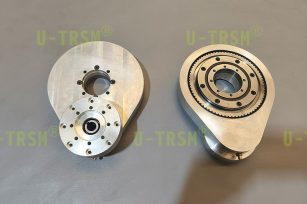 Lightweight design and performance of U-TR...
In the field of high speed automated mechanical equipment, the performance and light weight of the core drive compone...
Detailed instructions Send mail
Brief analysis of gear safety factor of spur gear slewing drive
Publish time:2024/02/24 News Views:404
The service life of spur gear slewing drive is a common concern for customers and it is also a common issue that our engineers need to consider during the design phase. If you want the slewing drive to be safe and durable, the first consideration is the safety factor, which requires safe output torque and load within specified conditions. In this article, we will briefly analyse the safety factor of gears in terms of their ability to resist loads, tooth surface wear resistance and impact resistance.
1. The safety coefficient of gears directly determines their ability to resist loads. In the design process of gears, the higher the safety coefficient, the gears are able to withstand larger loads, thereby extending their service life, and on the contrary, the lower the safety coefficient, the teeth are prone to bending or breaking.
2. Gear tooth surface wear resistance is also an important factor affecting its service life, in the process of gear transmission operation, the tooth surface is subject to friction, a higher safety coefficient means that the gear tooth surface has a better wear resistance. Conversely, the tooth surface is easy to wear, resulting in a decrease in gear accuracy and even stuck phenomenon.
3. In some working environments, gears may be subjected to sudden impact loads or vibrations, a higher safety factor can enhance the impact resistance of gears, so that they can better withstand external shocks and vibrations during use, thereby extending their life.
When designing the slewing drive, U-TRSM designers will constantly communicate with customers to ensure the stability and reliability of the gear transmission system in practical applications, and provide customers with high-quality solutions. This article only analyzes several factors in general, of course, it also needs to analyze specific situations. The U-TRSM designers have a lot of working experience and have designed many types of slewing drives to meet various scenarios, if you have such needs or have any questions about this product, please contact us.
- What is the cause of the slewing ring damage?
- Why are high-precision spur gear slew driv...
- Analysis of the force of the spur gear sle...
- Why is it not recommended to repair the ge...
- Introduction to several common worm types ...
- Synergistic development of industrial robo...
- How could we increase the slewing bearing ...
- The classification of slew drive toroidal ...